A Philadelphia Girl Who Visited Washington
[This was transcribed from an old typewritten manuscript, written by Edward Hurst Brown (the father of Isabel Halsey Grier, a.k.a. “Dowie”).]
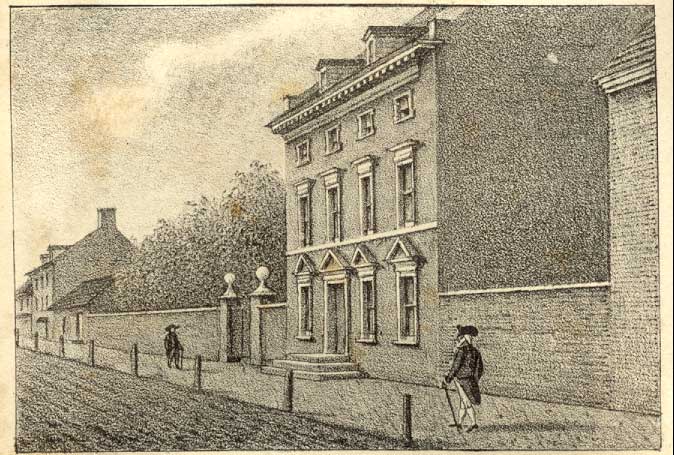
When Philadelphia was the seat of the Federal government, the town scarcely extended further west along High Street – the principal thoroughfare of the city, now called Market Street – than Ninth Street and the market houses, which were built in the center of the roadway [?], stopped at Fourth Street. West of this point were private residences of a good class. One of these, near Sixth Street, had been the town house of Robert Morris, the well known banker and the financier of the Revolution, but when the National capital was removed from New York, it was taken by the City Corporation for the use of President Washington, who lived in it until the end of his administration in 1797. The next door house was the residence of George Wescott, a prosperous merchant, whose family had come to the Quaker City in the days when the Penns were still Proprietors of the Colony.
While Pennsylvania was still a British possession, George Wescott had married Patience Story, and though some of her family had been Tories, and fought under the King during the War of Independence, the Wescotts were loyal to their native land, and their two eldest sons were with the famous First Troop Philadelphia City Cavalry at the Battle of Trenton. At any rate a warm friendship grew up between the Washingtons and the Wescotts, more particularly between the younger members of the two families, for the young Custisses, Mrs. Washington’s grandchildren, were about the same age as some of the Wescott children.
Elizabeth, the fifth child of George and Patience Wescott, — more familiarly known by her friends and family as Betsey, — was born in Philadelphia March 16, 1772, and because of her loveliness and wit became one of the reigning belles of the city, during the years that it was the seat of government. In a very interesting volume of notes and reminiscences, written by Thomas Twinning, and Englishman who had held an important government position in India, and who returned home by way of this country in 1796, he mentions the fact, under the date of April 28, that he met Miss Wescott while on a visit to the City of Washington, then little more than a carefully drawn engineer’s plan and a few buildings in course of construction. He was staying at the house of Thomas Law, another Englishman who had been in the East Indian service, but who had left it to settle in this country, and had married Eliza Parke Custis, one of Mrs. Washington’s grand-daughters, and built himself a residence in the infant city that was in time to be the Nation’s capital. Twining tells us that “in the evening, Miss Wescott of Philadelphia arrived. Though possessing a sort of celebrity for her talents and literary attainments, her manners were particularly unaffected and agreeable.” Several days were spent in sightseeing, one of them being given up to a trip down the Potomac in a large row boat, returning late in the evening, when “the moon shone so beautifully upon the still, broad stream that all were struck with the loveliness of the scene. Miss Wescott even made it the subject of some lines, whose elegance only was all that the visiting Englishman could recollect when he came to write his reminiscences.
On the first of May, 1796, Mr. Twinning started for Philadelphia, going the first stage of his journey in Mr. Law’s private carriage. He says: “As Miss Wescott was going to Georgetown, I had the pleasure of her company so far. She stopped at the house of Mr. Stuart, where she introduced me to her friends the Misses Breck, two other young ladies from Philadelphia.” One of these, a very lovely girl, Lucy Breck, was Betsey Wescott’s most intimate friend, and the fiancée of her brother Robert.
We have every reason to suppose that Miss Wescott prolonged her stay in this neighborhood for some weeks, for one of her great nieces has now in her possession a letter written June 27, 1796, describing a visit she had just paid to the President’s family at Mount Vernon. We know from the published letters of Washington that he had gone from Philadelphia to Mount Vernon sometime between the ninth and the twenty-fourth of June. Only a portion, however, of Elizabeth Wescott’s letter now remains, covering four pages of old fashioned and time yellowed writing paper. It is specially interesting as giving us a glimpse of the home life of the Washingtons, written with all the frankness a young girl would use in a letter to her mother, who was herself intimate with the family whose life was being described.
[There is a break in the manuscript here. It jumps from page 4 to page 8, with a hand-written note “Take in letter” at the bottom of page 4.]
Here the letter abruptly breaks off, the remainder which was on another sheet having long ago been lost.
Whether Miss Wescott paid the subsequent visit to Mount Vernon that she wrote her mother she had promised, it is impossible now to tell, but family tradition has it that she rode behind Washington on a pillion, over his plantation. If the tradition is correct, it may have been on the later visit.
The young Mr. Fayette she speaks of was George Washington Motier de Lafayette, son of the distinguished general who fought in the War of Independence, who driven from France by the Revolution in that country, was at the time in the Austrian prison of Olmütz. His wife and the daughters voluntarily shared his imprisonment, after having first confided the son to the care of Washington, by whom he was most cordially received and invited to become an inmate of his household. In a letter to Thomas Pinckney, dated May 22, Washington speaks of the “visible distress” of the son of Lafayette, “who is now with me, and grieving for the unhappy fate of his parents”.
In spite of Elizabeth Wescott’s loveliness of character, her vivacity and talents, this bright girl was destined to be cut off in the full flower of her youth. In the summer of 1798, Philadelphia was visited by a terrible epidemic of yellow fever. All the inhabitants who could do so, fled from the city to avoid the pestilence. The Wescotts shut up their town home, and the entire family moved to their country seat at Point-No-Point, near Frankford. Yet in spite of all the precautions which had been taken, Elizabeth Wescott hand her close friend Lucy Breck – the Brecks were near neighbors – both became victims of the plague and were buried in a common grave in All Saints burying ground near Frankford. How they became exposed to the disease was never known, but it was supposed they had either bribed the coachman to drive them to the city; or else that he had surreptitiously used the family carriage for some of the numerous funerals, pocketing the large fees received for his own private gain, and thus carrying the deadly germ home to his employer’s family.
A curious old miniature, in a plain gold frame, owned by a niece of Elizabeth Wescott, has preserved her portrait in the quaint costume of the period. On the reverse is an old fashioned picture, representing the sorrowing mother weeping over the tomb. The tree and other parts of the picture are made from Lucy Breck’s hair. The tiny braid the surrounds it, forming an inner frame, is a lock of hair from the head of Elizabeth Wescott. On the pictured tomb, in very fine letters, one may read the words “Sacred to the memory of E. W. and L. B.”, while on the scroll above is the inscription: “On angels’ wings our souls are borne.” This miniature is regarded by its owner as a priceless treasure; an invaluable memento of the lovely Philadelphia girl who visited Washington a hundred years ago.
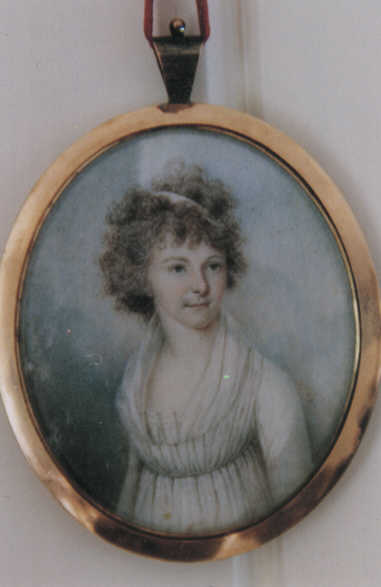
The Front of the Miniature of Betsy Wescott
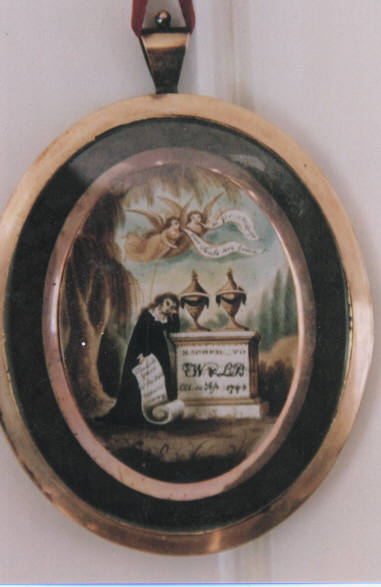
The back of the Betsy Wescott Miniature
Added Notes by Tom Lathrop
This miniature was in a box of family pictures which my mother found when she was cleaning out Dowie’s condo in Hamden. Since I was interested in genealogy and family history, I ended up with that box. In 1997 or 1998, the PBS television show “Antiques Roadshow” came to Rochester, and I brought in the miniature to be appraised. It was selected as one of the appraisals to be shown on TV. The show was first aired in 1999. The appraiser told me that the miniature was painted by James Peale, the finest painter of miniatures in Philadelphia at the time, and the brother of the well-known painter Charles Willson Peale. Several years later I visited the Philadelphia Art Museum. They have a Peale Family room which includes about 20 miniature portraits by James Peale, as well as paintings by Charles Willson Peale and other members of the Peale family.
The front of the miniature was probably painted from life. The back was done after the deaths of Betsy Wescott and Lucy Breck.
In a 1769 tax list for George Wescott, Betsy Wescott’s father, I found two “Negros” in a list of his possessions. along with his dwelling, one horse, and one cow. I was disturbed to learn that an ancestor of mine had owned slaves, even though he lived in a northern state. The two slaves were probably house servants who lived with the family.
The image below (from Wikipedia) is an 1830 lithograph of the “President’s House” in Philadelphia. That is the house that George Washington lived in when he was the President and the government was in Philadelphia. The Wescott family lived next door to this house. This image gives an idea of what the neighborhood probably looked like at that time.