The Runks and Rockefellers were Dowie’s only German ancestors, as far as I know. Dowie’s ancestors include Samuel Runk, who served in the milia during the American Revolution, and his son John Runk, who was a U.S. Congressman.
The Palatine Germans
The Palatinate is a region in southwestern Germany that borders the Upper Rhine river. During the Thirty Years War (1618 – 1648) there was heavy fighting in the area. The economy collapsed and many civilians were slaughtered. In the early eighteenth century, during the War of the Spanish Succession, the Palatinate was overrun by French armies. In addition, a harsh winter in 1708-1709 destroyed crops and brought famine to the region. About that time, a book was published in the German language describing the riches and ease of life in the British colony of Carolina. That resulted in thousands of residents of the Palatinate leaving, first for Holland or England and later for the British colonies in North America.
In North America, many Palatine Germans settled in the Hudson Valley and the Mohawk Valley in New York, and in southern Pennsylvania. The “Pennsylvania Dutch” were actually Palatine Germans. In addition, some Palatine Germans, including our ancestors Johann Peter Rockefeller and Jakob Runk, settled in Hunterdon County, in western New Jersey.
Johann Peter and Elizabeth Christina (Runkel) Rockefeller
Johann Peter Rockefeller was born in 1682 in Weid, in the Rhineland-Palatinate region of present-day Germany. He married Anna Maria Remagen about 1707. They had six children, two boys and four girls. One of the boys and one of the girls died in infancy. Anna Maria died in 1719. In 1720 Johann Peter Rockefeller married Elizabeth Christina Runkel as his second wife. They came to America in 1723, presumably with several children. The ship that they sailed on intended to land in New York, but heavy northeast winds prevented that and it landed in Philadelphia instead. From there Johann Peter Rockefeller and others in his party started to go to the Hudson River valley, but many found the land in Hunterdon County, NJ to be so good that they settled there. Johann Peter and his family were among them. He leased a farm near Somerville, NJ for 6 years. Then he bought a farm in Rocktown, Hunterdon County, NJ, where he lived for the rest of his life.
Johann Peter Rockefeller was an ordinary farmer in colonial New Jersey, but he was also the third great-grandfather of John D. Rockefeller, the founder of Standard Oil Company and one of the wealthiest Americans of all time.
Jakob and Ann (Rockefeller) Runk
Jacob Runk (or Runck) was born in 1716. He came from the Palatine area of German to America in 1738. He sailed in the ship Winter Gallery, leaving from Rotterdam and landing in Philadelphia. Jacob took the oaths of allegiance in Philadelphia on Sept. 5, 1738. He settled in Amwell township, Hunterdon County, NJ. He was a farmer.
Jakob married Ann Rockefeller, daughter of Johann Peter and Elizabeth Christina (Runkel) Rockefeller (above). Jakob and Ann had seven children, five boys and two girls.
Samuel and Margaret (Snyder) Runk
One of the sons of Jakob and Ann Runk was Samuel Runk. He was born in 1754 in Amwell, New Jersey. During the Revolution he served as a private in the Hunterdon County, New Jersey militia in various tours of duty between 1776 and 1778. He took part in the so-called Battle of Short Hills, near Scotch Plains and Edison, New Jersey on June 26, 1777. Samuel married Margaret Snyder. They had six children, three boys and three girls. Samuel lived long enough to receive a United States government pension for his service (file number S-6030). He died in April 1847 at age 91, and Margaret died in September of the same year at age 84. They are both buried in the Rockefeller-Wikoff Burying Ground in Rocktown, Hunterdon County, NJ.
John and Emma (Ten Broeck) Runk
John Runk was born in 1791 in Milltown, New Jersey, the son of Samuel and Margaret (Snyder) Runk. John grew up in Hunterdon County, N.J and attended the district schools. In 1811 he married Evelyn Ten Broeck. Her ancestors included several notable families in the Dutch colony of New Netherland (which later became New York).
John took charge of the mills and general store on his father’s property in Milltown. He was an unsuccessful candidate for sheriff of Hunterdon County, NJ in 1830. However, he ran again in 1836 and won, serving for 2 years. He was a presidential elector on the Whig ticket of Harrison and Tyler in 1840 and of Taylor and Fillmore in 1848. He was elected as a Whig to the Twenty-ninth U.S. Congress (March 4, 1845-March 3, 1847). He ran for reelection in 1846 but was defeated. He ran for Governor of New Jersey in 1850 on the Whig ticket but was defeated by the Democratic candidate, George Fort.
John and Emma had eleven children, seven boys and four girls.Emma died in 1848. She is buried in Rosemont Cemetery in Rosemont, New Jersey.
John moved to Lambertville, Hunterdon County, NJ in 1854 where he became a merchant in the milling business. He was a Mason for most of his adult life. In 1855 he married as his second wife Amy M. Skillman, the widow of Abraham S. Skillman. John died in 1872 and is buried in Rosemont Cemetery in Rosemont, New Jersey. Amy died in 1896.
William and Ann Rebecca Halsey (Seymour) Runk
William Runk was born in 1814 in Kingwood, New Jersey, the oldest son of John and Emma (Ten Broeck) Runk. He moved to New York City and became a grocer. In 1848 he married Ann Rebecca Halsey Seymour, the daughter of William N. and Ann Rebecca Garthwaite (Halsey) Seymour.
William Runk’s grocery store was on Greenwich Street in lower Manhattan, two or three blocks north of where the World Trade Center is today. Between 1848 and 1860 William and his family lived at various addresses in lower Manhattan. By 1861 they had moved to 249 Carlton Avenue, a brownstone in the Greene Park neighborhood of Brooklyn. Two advancements in transportation in the early nineteenth century made it possible for William Runk to live in Brooklyn and run a grocery store in Manhattan: the development of steam-powered ferries and the introduction of horse cars.
Steam-powered ferry service between Brooklyn and Manhattan began in 1814. For the first time it was possible for someone to live in Brooklyn and commute year-round to their workplace in Manhattan. The Brooklyn Bridge wouldn’t be completed until 1883, and the subway didn’t exist, so the only way for most people to cross the East River from Brooklyn to Manhattan was by ferry.
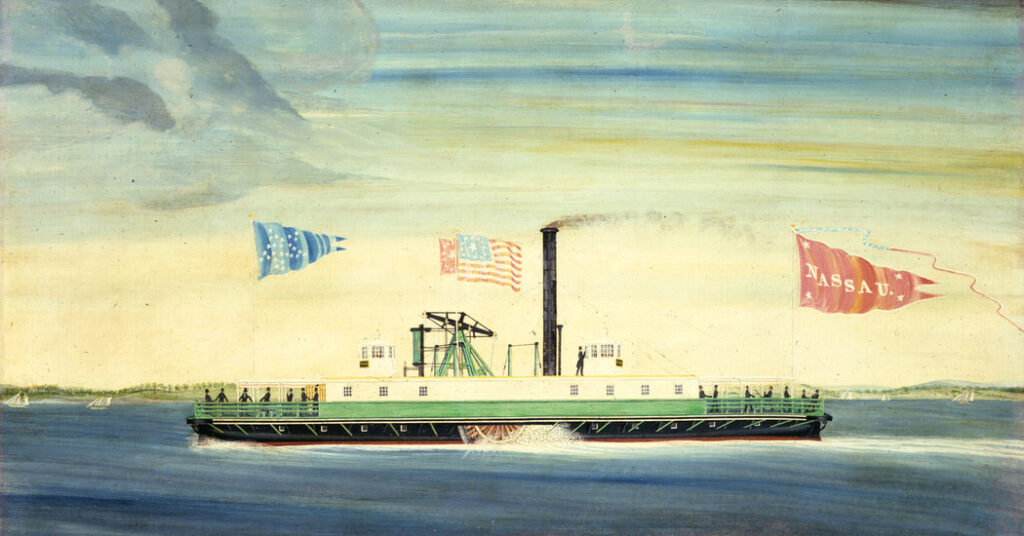
A Typical Steam-powered Ferry of the 1840s and 1850s
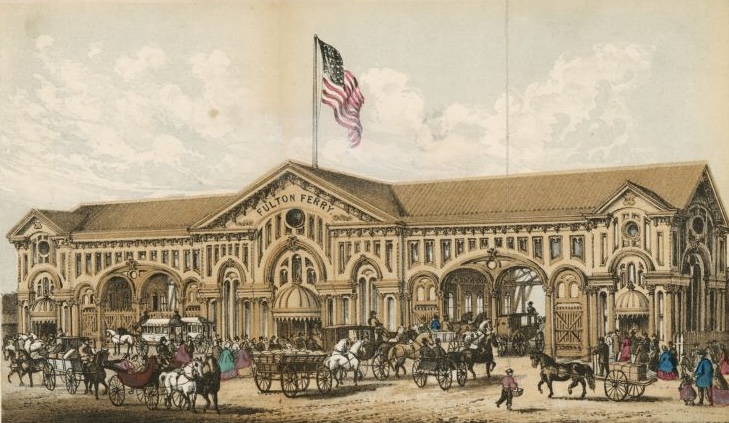
William’s commute to work may have included a ride on a horse car, which was a horse-drawn streetcar which ran on metal rails in the street. This was similar to a trolley except that it was pulled by a horse. A horse car line opened along Fulton Street in Brooklyn in 1854, starting at the Fulton Ferry terminal and running east. William Runk probably had to walk a few blocks to get to the horse car line, but then he could ride a horse car to the ferry terminal and take the ferry to Manhattan. If that’s what he did, he would have passed through the ferry terminal in the picture below.
William and Ann Runk had eleven children, seven girls and four boys. Sadly, three of their children had died young, at ages 11, 6, and 2. I don’t know what they died of. However, child mortality was unfortunately fairly common in the nineteenth century, mostly due to infectious diseases like smallpox, tuberculosis, diphtheria, cholera, etc.
In early 1871 the Runk family seemed to be doing reasonably well. Their eight surviving children ranged in age from under a year to 21 years old. They had enough money that they could afford to live in a good neighborhood, with a live-in maid to help with the housework and the cooking. But then, starting in late 1871, the Runk family had a series of catastrophes. William Runk died in November 1871 at age 57, Ann (Seymour) Runk’s mother Ann (Halsey) Seymour died in December 1871, and Ann (Seymour) Runk died in July 1872 at age 42. Jenny Coryell Runk, the youngest child of William and Ann, died a few days after her mother. Jenny was two months shy of her second birthday. William Runk’s father John Runk died in September 1872. In less than ten months, the surviving children of William and Ann Runk lost both their parents, two of their grandparents, and their baby sister.
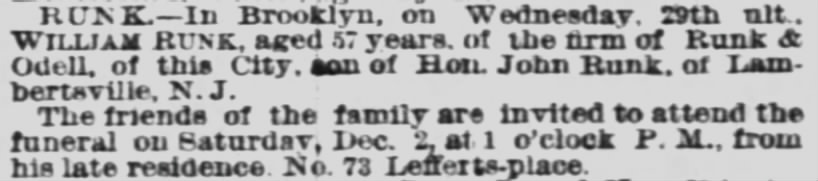
William Runk, his wife Ann (Seymour) Runk, their four children who died young, and Ann Runk’s parents William N. and Ann (Halsey) Seymour are all buried in lot 334, section 95 of Green-Wood Cemetery, a very large cemetery in Brooklyn.
After the death of their mother, at least four of the Runk children were taken in by their aunt Mary (Runk) Barcroft, who lived in Philadelphia. Two or three more might have been taken in by their uncle, Charles Walton Seymour, an attorney who was living in Yonkers, NY.
Sarah Barker Runk, one of the four Runk children who were taken in by Mary (Runk) Barcroft, eventually married Edward Hurst Brown. Click the button to go to the Brown family page, showing his ancestry.