Dowie’s maiden name was Isabel Halsey Brown. This is the story of her Brown ancestors. Brown is a difficult name to research because it is so common. Fortunately I had some family documents to help me.
Thomas and Sarah (Carter) Brown
Thomas Brown was born in 1722. I’m not sure where he was born or who his parents were. Information from my family says that he came from England and settled in Newark, New Jersey. However, I corresponded with another genealogical researcher who believed that he was the son of David and Jean Brown of Newark. If that is the case, then he was descended from John and Mary (Burwell) Brown, who came from Milford, Connecticut to Newark, New Jersey. They were part of a group of Puritans who left Milford in 1666 after the union of the Connecticut and New Haven colonies. Those Puritans were afraid that they wouldn’t be able to continue to enforce their strict church rules in the merged colony. They were the founders of Newark.
Thomas Brown married Sarah Carter in August 1778, when he was 56 and Sarah was 22. They had one child, a boy who was also named Thomas. The elder Thomas died less than four years after his marriage to Sarah, in February 1782. He was buried in the Old Burying Ground in Newark. In 1889 he was re-interred in the Fairmont Cemetery in Newark. His wife Sarah (Carter) Brown died in 1827 at age 71. She is buried in the churchyard of the Scotch Plains Baptist Church in Scotch Plains, New Jersey, where her son Thomas was the minister.
Rev. Thomas and Mary Kenann (Lewis) Brown

Rev. Thomas Brown
Thomas Brown was born in 1779 in Newark, New Jersey, and grew up there. When he was only two years old, his father died, leaving him a considerable estate. This money was lost due to fraud or mismanagement, and his mother apprenticed him to a Mr. Ayres to learn the trade of a shoemaker. He became quite religious at the age of 16, and at 18 began to study for the ministry of the Presbyterian Church. A couple of years later he changed his views on baptism and became a Baptist. He was licensed as a minister of that church on March 26, 1803. However, he did not think that his education was adequate to serve as a minister, so he began teaching at a private school at Amboy, doing much reading on many subjects, and theology in particular. After a few months at Amboy, he entered the Academy at Pennepack, Pennsylvania (near Philadelphia). He stayed there until 1805, when he was offered a position as pastor of the Baptist Church at Salem, NJ. He was ordained early in 1806. About 1808 he married Mary Kenann Lewis, the daughter of John and Sophia (Compton) Lewis. Rev. Brown stayed at Salem for 3 years, and then in 1808 he accepted an invitation to be the minister of the Baptist Church at Scotch Plains, New Jersey. He stayed in Scotch Plains for twenty years. During that time Thomas and Mary had ten children, six boys and four girls. A wood frame addition was added to the rectory in 1810 to house Rev. Brown’s large family. That rectory, a fine old stone building, is still standing. (The present church building was built in 1871, long after Rev. Brown’s had died.)
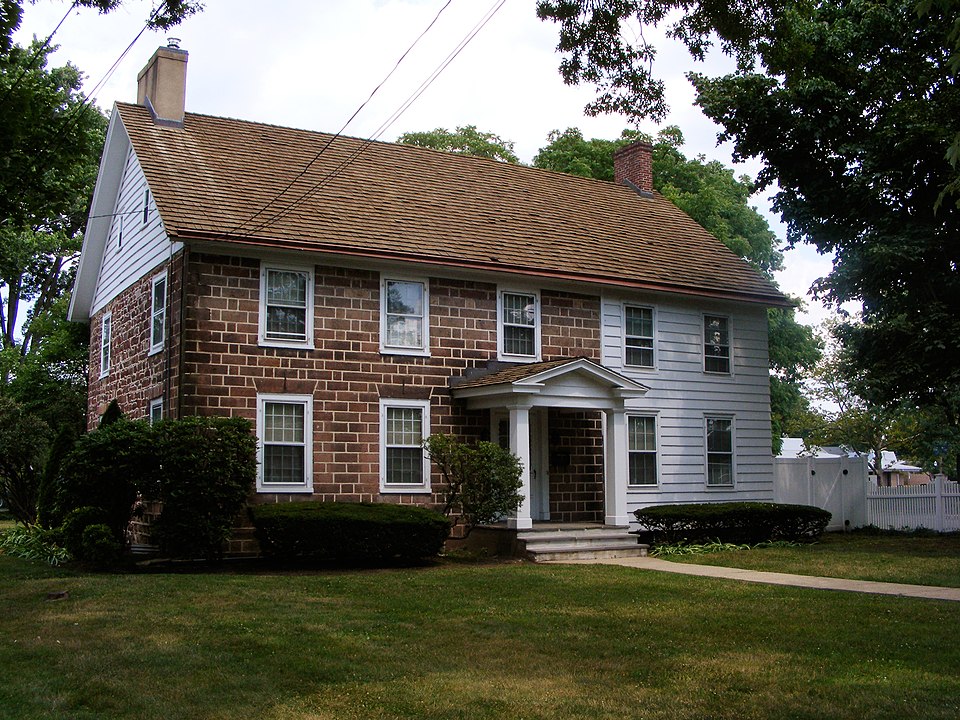
Old Baptist Parsonage, Scotch Plains, New Jersey – (Photo by Josconklin – Own work, CC BY-SA 3.0, https://commons.wikimedia.org/w/index.php?curid=20996736)
There is a Wikipedia page about the parsonage.
In 1828 Rev. Brown accepted an invitation to be the minister at the Baptist Church in the Great Valley, in Tredyffrin, Pennsylvania.
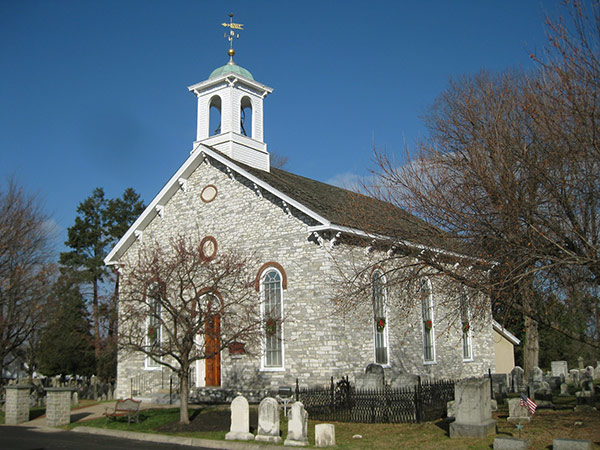
The Baptist Church in the Great Valley
This church was built in 1805, so it probably looks very much as it did when Rev. Thomas Brown was the pastor there. It is near Devon, Pennsylvania, a small town about 20 miles northwest of Philadelphia and a few miles south of Valley Forge. Rev. Thomas Brown was the pastor there until his death in January 1831. He is buried in the churchyard there, although there doesn’t seem to be a stone for him. His wife Mary died in 1859. She is also buried in that churchyard, and there is a stone for her.
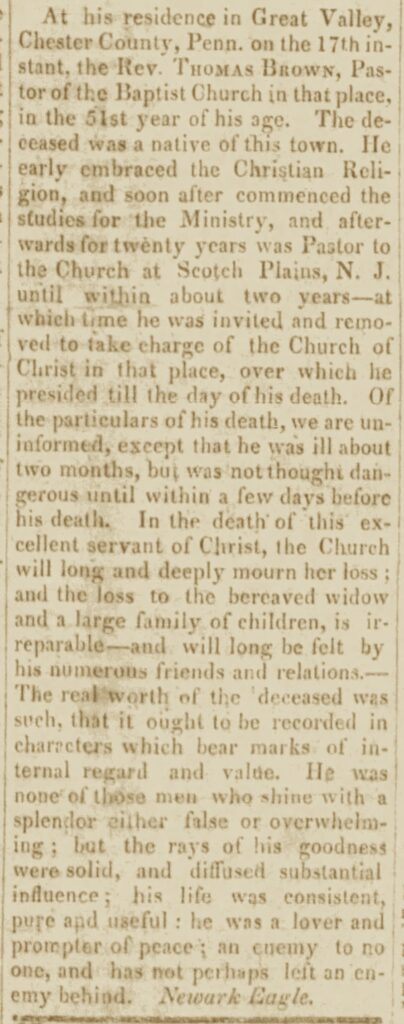
The following anecdote about Rev. Thomas Brown is from a letter written by another Baptist minister, Rev. Thomas Winter. It was part of a tribute to Rev. Brown.
When Mr. Brown was yet a young man, he went from Perth Amboy to fulfill a preaching appointment, in the neighborhood of South Amboy, on the other side of the Raritan River. He had to cross it in a small ferryboat worked by oars. The mouth of that river, in the channel, is sometimes very dangerous, and, for such craft, unnavigable; especially so, when the wind sets down the river, or the reverse, and meets the tide. On the occasion referred to, the wind was boisterous, and the waves were high. In the little boat were a number of young persons; and one in whom the voyager felt a special interest. There was also another, then a child, who, some years subsequently, became known to me, and from whom I received the account. Well the wind blew, and the waves tossed about at pleasure the tiny vessel. The danger seemed great, and the terror of the passengers was proportionally great. In the midst of the cry of distress, Mr. Brown broke out with his strong, musical voice, to the good old tune, I think, of Shirland:
“The God that rules on high,
“And thunders when He please,
“That rides upon the stormy sky,
“And manages the Seas:
“This awful God is ours,
“Our Father and our Love, &c.”
All were hushed, and there was a great calm in their feelings. And with the vigorous strokes of the oarsmen, the boat was safely brought to the welcome beach, and all gladly stepped on terra firma.
Philip and Natalie (Wescott) Brown
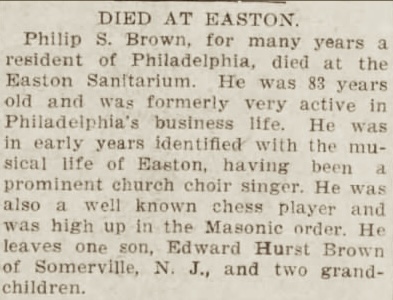
Philip Sydney Brown was born in 1825 in Scotch Plains, New Jersey. In December 1856 he married Natalie Josepha Wescott, the daughter of Robert and Catherine (Browne) Wescott. Philip and Natalie Brown lived at 3423 Race Street in Philadelphia. They had two children, a boy, Edward, and a girl, Natalie.

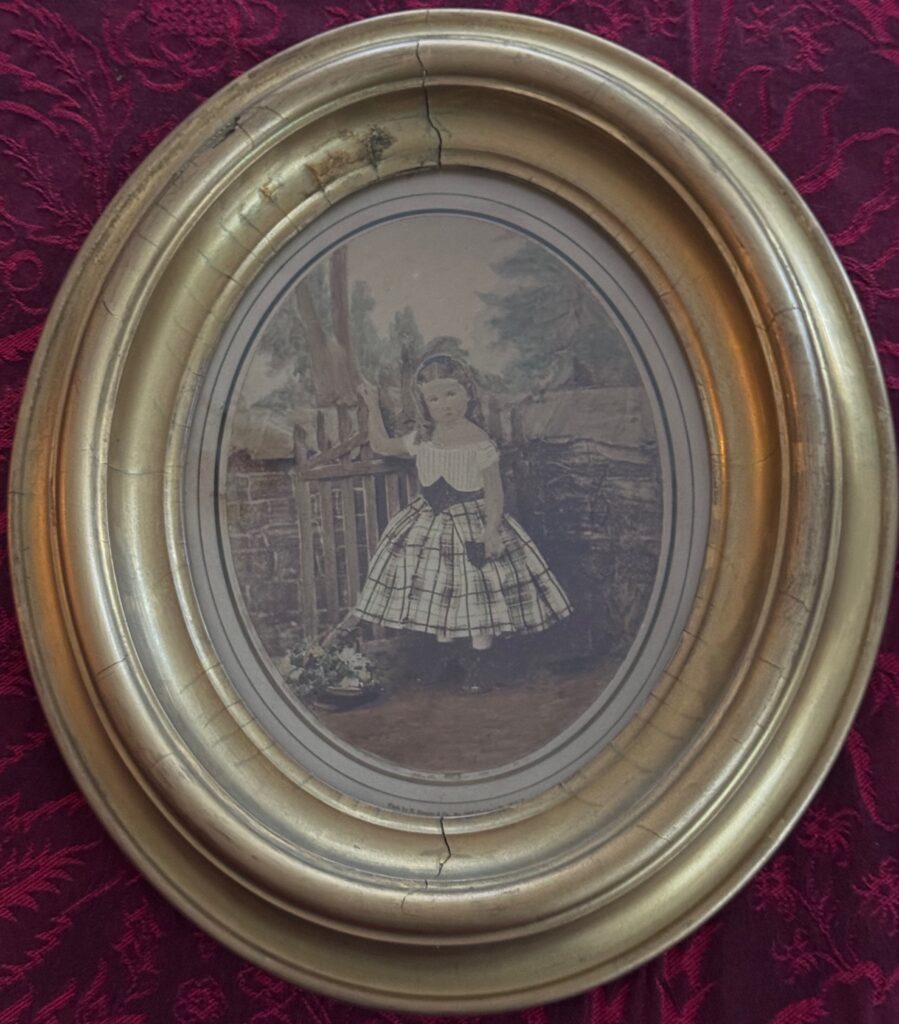
Edward and Natalie Brown
In 1870 Philip was a clerk in a store, and in 1880 he was a salesman.
Natalie (Wescott) Brown died in December 1907 in the home of her son Edward in Somerville, New Jersey. Philip died in November 1908 at the Easton Sanitarium in Easton, Pennsylvania. His cause of death was listed as “dementia senilis”. He is buried in the West Laurel Hill Cemetery in Bala Cynwyd, Pennsylvania.
Edward and Sarah (Runk) Brown
Edward Hurst Brown was born in Philadelphia in 1859, the son of Philip and Natalie (Wescott) Brown. He studied architecture at the University of Pennsylvania, graduating in 1879. He then went to work for Wilson Brothers as a draftsman. In 1881 he began working as a draftsman for the Philadelphia, Wilmington, and Baltimore Railroad. In 1883 he worked as an assistant engineer for maintenance for the Pennsylvania Railroad at Altoona. Later that year he launched his own architectural firm, and in 1886 he took on a partner, Samuel H. Day.
In October 1890, Edward H. Brown married Sarah Runk, the daughter of William and Ann (Seymour) Runk. They had two children: Isabel Halsey Brown, born in 1892, and Philip Sidney Brown, born in 1896.
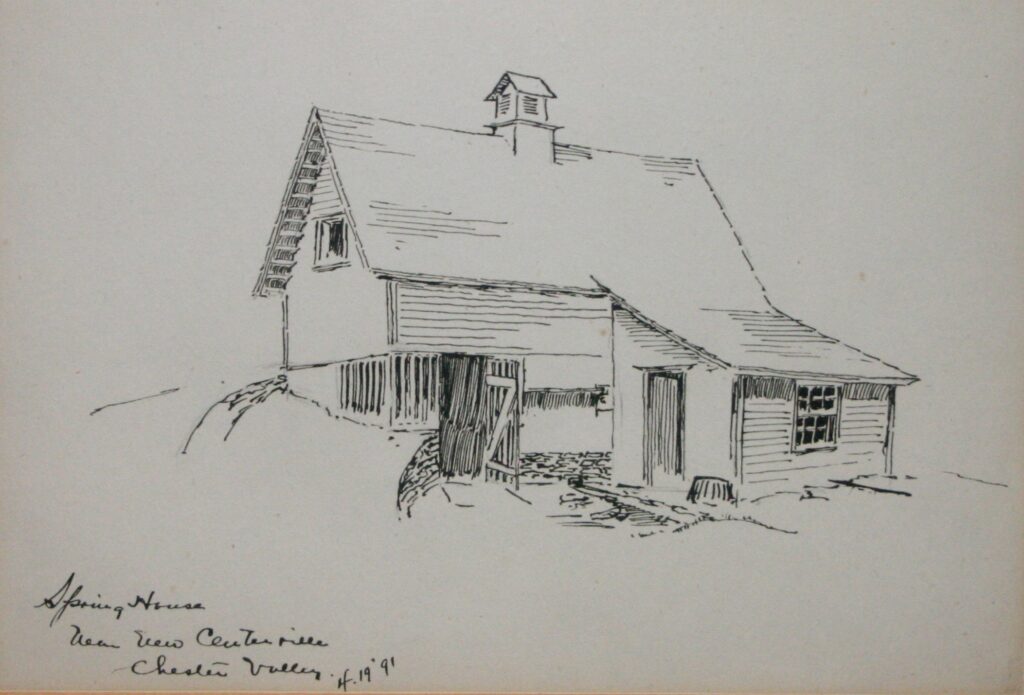
Edward was a skilled architectural draftsman, and he liked to make sketches of buildings that interested him. The sketch above is one that he made in 1891 of an old spring house in the Chester Valley, near Philadelphia.
In 1891 the partnership of Brown and Day was dissolved and Edward Brown became the advertising manager for Harrison Brothers, a local paint firm. By 1893 he was editor of the periodical Painting and Decorating. In that role, he would sometimes present papers at national conventions of painters’ organizations. When the editorial office of Painting and Decorating moved from Philadelphia to New York City, he moved with it.
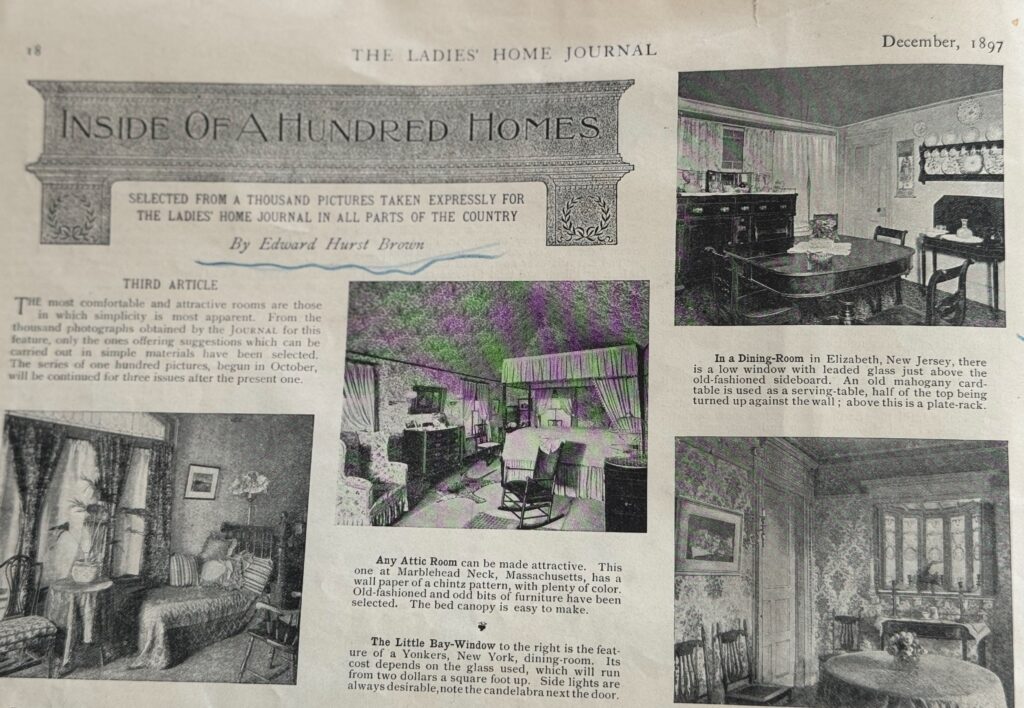
By 1898 Edward Brown was in the general advertising business in New York City. He was also writing articles for the Ladies’ Home Journal, which at that time included several articles per issue on architecture or interior design. The image below shows the first part of a two-page photo essay that Edward did for the December 1897 issue.
Edward also worked as a special department editor for Painters’ Magazine. By 1900 Edward and his family were living in Elizabeth, New Jersey.
In about 1905, Sarah joined the DAR (Daughters of the American Revolution), based on the service of her ancestor Capt. John Carter in the Revolution .
Between 1915 and 1920, Edward and Sarah moved to Mt. Carmel, near Hamden, Connecticut, to be near their children.
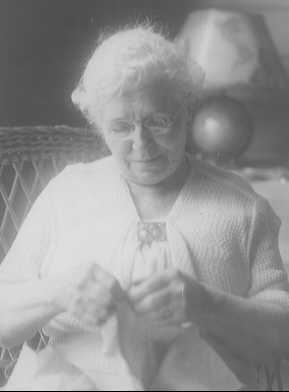
Edward died in New Haven, Connecticut in 1930, at age 71. Soon afterward, his widow Sarah moved in with her daughter and son-in-law Isabel and Edgar Grier and their family.
Sarah (Runk) Brown
She continued to live with them until her death in 1944.
Both Edward and Sarah are buried in the Evergreen Cemetery in New Haven (section 13).
Edward and Sarah Brown’s daughter Isabel married Edgar Grier Jr. in 1917. Click the button to go to the page with their story.